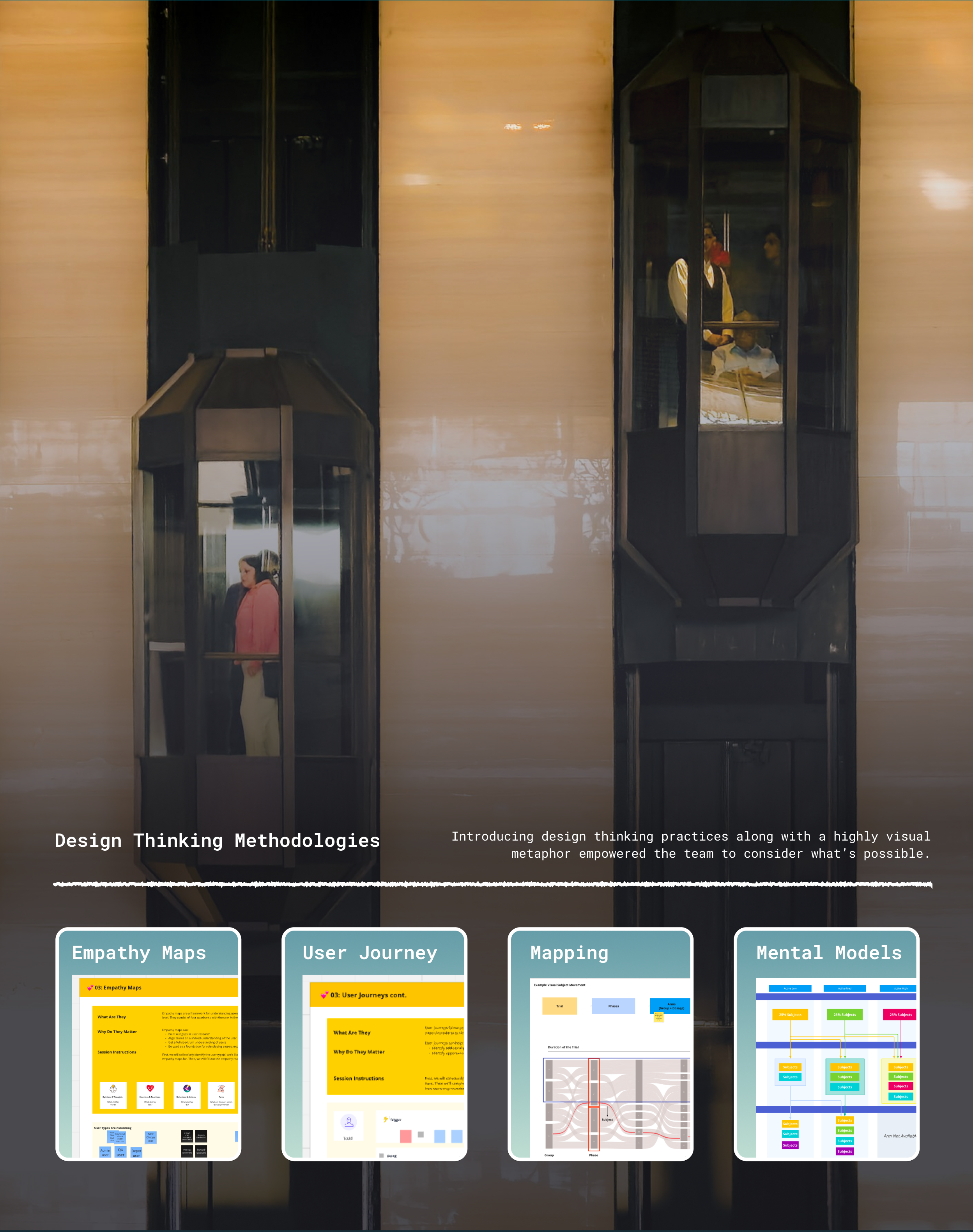
How an elevator analogy became the key to unsticking teams deep in technicalities.
I joined the small but mighty team to modernize their clinical trial forecasting experience. The platform could support an impressive range of business rules and workflows, but was increasingly difficult for new users and cross-functional teams to understand. The team was hungry for the next stage of growth, but first, we needed to step out of the weeds to see the horizon.
Problem Framing
After some initial stakeholder interviews and collaborative working sessions, I realized that the product experience was a symptom of a larger problem – poor UX maturity and stakeholder misalignment. Every discussion uncovered another rule, another edge case, and another reason why change was impossible.
Shared Understanding
Looking for a way forward, I reframed clinical trial rules as a system of elevators moving people through buildings. Buildings represented groups, floors represented stages, and elevators represented the rules and conditions that governed movement between them. Everybody can understand an elevator.
Gaining Momentum
The elevator framework shifted conversations from implementation details to system and experience design. Building on that momentum, I introduced collaborative design critiques, ideation workshops, and additional design-thinking practices that helped move conversations from what’s-not-possible towards what-if’s.
This project reinforced that many experience challenges originate not in the final user experience, but in how complexity is navigated internally.